A Professional's Take on the New Thumb Trackball Wired
Introduction
The evolution of the computer mouse has been characterized by a constant tension between traditional design and ergonomic necessity. For the modern professional spending eight to twelve hours a day at a digital workstation, the repetitive motion of a standard mouse is not just a nuisance; it is a primary contributor to repetitive strain injuries (RSI) and chronic wrist fatigue. Among the various alternatives, the trackball has remained a stalwart choice for power users, and the New Thumb Trackball Wired represents a refined iteration of this specialized tool. By separating the navigation of the cursor from the physical movement of the device, this thumb-operated peripheral offers a static footprint that addresses both ergonomic concerns and desk real estate issues.
Professional users—ranging from software engineers and graphic designers to financial analysts—increasingly find themselves gravitating toward thumb-operated trackballs because they offer a familiar transition from traditional mice. Unlike finger-operated trackballs, which require a significant shift in muscle memory, the thumb-operated design retains the classic button layout and scroll wheel placement. The New Thumb Trackball Wired prioritizes precision and reliability above all else. In an era where wireless connectivity is often touted as the ultimate convenience, the decision to remain wired speaks to a specific demographic: those who value zero latency, no battery management, and a secure, interference-free connection. This article explores the technical nuances, the day-to-day ergonomic impact, and the professional utility of this device from an editorial perspective.
Detailed Product Analysis: Engineering for Precision
At its core, the New Thumb Trackball Wired is built around a high-performance optical sensor that tracks the movement of a 34mm ball. The chassis is sculpted with a pronounced arch, specifically designed to support the natural curve of the human palm. This anatomical alignment ensures that the hand rests in a neutral position, reducing the tension in the forearm muscles that usually stays flexed during traditional mouse use. The surface material often features a soft-touch matte finish, providing enough friction to prevent the hand from slipping during intense workloads while maintaining a premium feel.
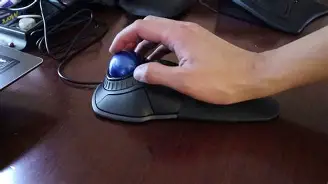
The primary buttons—left and right click—are equipped with mechanical switches rated for millions of actuations. For a professional, the tactile feedback of these clicks is crucial for confirming actions without needing to glance at the screen. The scroll wheel, positioned centrally between the primary buttons, often includes a rubberized texture and a notched rotation mechanism, allowing for precise scrolling through long lines of code or complex spreadsheets. Furthermore, the inclusion of dedicated "forward" and "back" buttons near the index finger's resting position streamlines web navigation and file management, making the device a productivity hub rather than just a pointing tool.
One of the most critical aspects of this wired model is the tracking resolution. Most professional-grade trackballs now include a dedicated DPI (dots per inch) switch. This button allows the user to toggle between different sensitivity levels instantly. High DPI settings are useful for traversing multi-monitor setups with minimal thumb movement, while lower DPI settings provide the granular control necessary for pixel-perfect photo editing or CAD (Computer-Aided Design) work. The wired connection ensures that these signals are transmitted at a high polling rate, eliminating the "stutter" or sleep-mode wake-up delays that can plague Bluetooth alternatives.
Maintainability and Longevity
Experienced trackball users know that dust and skin oils naturally accumulate over time around the internal bearings. The New Thumb Trackball Wired addresses this with a user-friendly maintenance design. The ball is typically held in place by a secure housing but can be easily popped out through a hole at the base. The internal tracking mechanism uses artificial ruby or ceramic support bearings, which are chosen for their hardness and low friction. This ensures that the ball glide remains smooth over years of use, provided the user performs a quick cleaning every few weeks. This focus on longevity is a hallmark of professional hardware, contrasting sharply with the "disposable" feel of budget office peripherals.
The Real-World Professional Experience
When transitioning to the New Thumb Trackball Wired, the most immediate benefit noted by professionals is the reduction in shoulder rotation. Because the trackball itself does not move, the elbow can remain tucked close to the body. For users working in cramped environments—such as small home office desks, server rooms, or audio production consoles—this static nature is transformative. You no longer need a large, clear swath of desk space to move a mouse; if the trackball fits, it works.
In creative fields like video editing, the trackball excels at scrubbing through timelines. The ability to give the ball a quick flick to travel across a 4K timeline, followed by a precise thumb adjustment to land on a specific frame, offers a level of kinetic control that a standard mouse struggle to replicate. Similarly, in programming, being able to keep the hand perfectly still while navigating thousands of lines of code reduces the "micro-fatigue" that accumulates over a long shift.
Shop the latest Electronics picks on Amazon.
Shop Amazon →Pros and Cons of the Wired Thumb Trackball
- Advantage: Ergonomic Relief – By eliminating the need to move the entire arm, the device significantly reduces the risk of carpal tunnel syndrome and general forearm strain.
- Advantage: Plug-and-Play Reliability – The USB connection removes the need for charging cables, AA batteries, or the occasional frustration of Bluetooth pairing drops.
- Advantage: Space Efficiency – Ideal for cluttered desks or limited workspaces, as the footprint remains identical regardless of cursor speed or distance traveled.
- Advantage: Precision Control – The dedicated DPI toggle and thumb-focused manipulation allow for a high degree of accuracy in technical software suites.
- Disadvantage: Learning Curve – New users may take several days to a week to develop the fine motor skills in their thumb required for high-speed navigation.
- Disadvantage: Cord Management – While reliable, the physical wire adds to desk clutter and may be less convenient for those who frequently switch between different workstations.
- Disadvantage: Specialized Maintenance – Unlike traditional optical mice, trackballs require periodic cleaning of the ball and bearings to maintain a smooth glide.
Professional Comparison: Wired vs. Wireless vs. Traditional
Understanding where the New Thumb Trackball Wired fits within the broader ecosystem of input devices requires a direct comparison of key performance indicators. The following table illustrates the trade-offs professionals must consider when selecting their primary tool.
| Feature | Wired Thumb Trackball | Wireless Thumb Trackball | Traditional Optical Mouse |
|---|---|---|---|
| Latency | Zero (Lag-free) | Low to Moderate | Low (Wired) / Moderate (BT) |
| Power Source | USB-Bus Powered | Internal Battery / AA | N/A (Wired) / Battery |
| Desktop Footprint | Static (Low) | Static (Low) | Dynamic (High) |
| Wrist Strain | Very Low | Very Low | High (Repetitive) |
| Precision | Very High (Stable) | High | Variable (Surface dependent) |
Professional Buying Guide: Is This Device Right for You?
Selecting a trackball is a personal decision that depends heavily on your specific workflow and physical comfort. If you are considering the New Thumb Trackball Wired, consider the following factors to ensure it aligns with your professional needs.
The Case for the Wired Connection
While wireless technology has improved, it is not infallible. In busy office environments with dozens of active Wi-Fi and Bluetooth signals, interference can lead to microscopic "skips" in cursor movement. For a professional doing high-stakes work, these skips are unacceptable. Furthermore, a wired model is always "ready." There is no anxiety about a battery dying in the middle of a presentation or the need to carry extra batteries in a laptop bag. If your workstation is permanent, the wired version is the superior choice for consistency.
Hand Size and Ergonomic Fit
Thumb trackballs are generally designed for medium to large hands. If you have particularly small hands, you may find the distance to the forward/back buttons or the scroll wheel a bit of a stretch. Conversely, the New Thumb Trackball Wired usually offers a substantial "hump" that provides excellent palm support for larger hands. It is often beneficial to check the dimensions of the device against your current mouse to ensure the arch height is comfortable for your grip style—whether you prefer a full palm rest or a "claw" grip.
Software Customization and DPI Needs
A professional's efficiency is often tied to shortcuts. Some wired trackballs come with proprietary software that allows you to remap every button on the device. If you use specialized software like Photoshop, Excel, or AutoCAD, the ability to map a specific macro to the "forward" button can save hours of time. Additionally, ensure the device offers a wide enough DPI range. A range of 400 to 1600 DPI is standard, but some modern sensors go even higher, which is essential if you are working on dual 4K monitors.
Environment and Surface Compatibility
One of the hidden benefits of a trackball is that it works on any surface. Because the sensor tracks the ball and not the desk, you don't need a mousepad. You can use it on a glass desk, a wooden table, or even on your lap if you are working from a couch or an airplane seat. However, the wired nature means you must have a clear path to a USB port. If you use a modern laptop with only USB-C ports, ensure you have a high-quality adapter or a hub that won't disrupt the power delivery to the device.
Refining the Workflow: Advanced Usage Tips
To maximize the utility of the New Thumb Trackball Wired, professionals should look beyond the basic click-and-drag. One advanced technique is the "acceleration" setting within your operating system. For trackball users, higher acceleration allows for large jumps across the screen with a fast flick, while slow movements remain incredibly precise for detail work. This effectively expands the "virtual workspace" of your thumb.
Find top-rated Electronics products at great prices.
See Deals →Another tip involves the physical placement of the device. Unlike a mouse, which you might move closer or further away throughout the day, the trackball stays put. Ergonomics experts suggest placing it so your shoulder is relaxed and your elbow forms a 90-degree angle. Because the device doesn't move, you can perfectly optimize your desk layout, placing your keyboard and trackball in the exact positions that minimize body strain, knowing they will stay there all day.
Cleaning and Maintenance Strategy
For a professional tool to remain professional, it must be maintained. The tracking ball on the New Thumb Trackball Wired is the heart of the machine. Over time, skin oils can create a film on the support bearings, causing a "sticky" or "gritty" feel. A simple weekly routine of popping the ball out and wiping it with a microfiber cloth is usually sufficient. For the internal bearings, a dry cotton swab can remove any lint accumulation. Avoid using lubricants or oils, as these will actually attract more dust and degrade the tracking performance over time. A clean trackball should feel nearly frictionless.
The Impact on Long-term Health
The transition to a thumb trackball is often motivated by pain—the dreaded "mouse wrist." However, the smartest professionals make the switch before the pain starts. By adopting a device like the New Thumb Trackball Wired, you are engaging in preventative ergonomics. The neutral hand position and the isolation of movement to the thumb prevent the "static loading" of the shoulder and the repetitive compression of the carpal tunnel. Over a decade-long career, the difference in joint health can be significant. While it may take a few days to feel as fast as you were with a mouse, the long-term trade-off for physical comfort is almost always worth the initial learning curve.
Conclusion
The New Thumb Trackball Wired is a testament to the idea that sometimes the best technology is that which stays grounded in core mechanical principles. By choosing to provide a reliable, high-precision wired connection, the manufacturers have created a tool that respects the needs of the power user. It addresses the fundamental ergonomic flaws of the traditional mouse while providing the specialized features—like DPI toggling and mechanical tactile feedback—that modern digital work demands.
While it may not be the flashiest peripheral on the market, its value lies in its invisibility; once the learning curve is conquered, the device vanishes into the user's workflow, allowing for hours of pain-free productivity and surgical precision. For the professional who is tired of the "mouse dance" and looking for a stationary, dependable, and ergonomically sound solution, the thumb-operated wired trackball remains a top-tier contender in the world of office electronics. It is a mature product for a mature professional, prioritizing the health of the hand and the efficiency of the task at hand above all else.